We arrived in Berlin around 10:30, caught a cab and headed off to our hostel to get a good night's rest for a packed day. We started the day off by first heading to the Eurolines office (are you noticing a sad pattern?). Unfortunately, all the buses to London were booked until Wednesday, but the lady offered us a spot to Brussels, so we took it, thinking we'd be closer to England and could find a way back somehow. It was then off to Brandenberger Tor to meet up for one of the free tours around Berlin. We begin in this square where the symbol of Berlin lies. Its a large gate that served as an entrance to the city, known as Brandenburg Gate. Also in this square was the US and French Embassy, along with Berlin's most expensive hotel, where Michael Jackson dangled his son out the window. We learned a bit about French versus Germany history, along with some older German history, then headed through the plaza to take a look at the Reichstag, where the German Bundestag, or federal government, sits. Here, there have been many important speeches that have changed Germany's history. On the other side of the street we saw a marker showing where the west side of the Berlin wall used to stand.
It was then off to the Holocaust monument. This monument was designed by an American Jewish architect. He has never really said much about the memorial, like why the stones are placed as they are or why they or the ground vary in height. He has left it up for interpretation, so that each person really has their own experience within the memorial. Our guide gave us a few ideas, suggesting it may be reminiscent of the Prague Jewish Cemetery or the stones representing lines of people or gravestones of those who lost their lives. As I walked through the memorial, and the stones grew up around me as the ground sloped down, I felt as though I were sinking deeper and deeper, almost as if being suffocated or trapped. To me, this feeling must have been similar to that of which the victims of the Holocaust experienced. As the ground rose back up, this disappeared, similar to how the Jewish people must have felt when finally liberated. Overall, I thought the memorial was rather interesting.
We then walked to a car park. Or as us American refer to it, a parking lot. At first, I was a bit confused. Our guide first explained that the buildings to our left were built when East Germany was under Communist rule. They housed those soldiers or spies who had done something wonderful for the Communist party and had the honor of living in these apartments. They built them so tall so those on the other side of the wall would see just how wonderful people in East Germany were living. But this was not the real reason we came to this site. Under our feet lied the remains of Hitler's bunker where he spent most of the months leading up to his death. Creepily enough, we actually stood above his bunker on the day he killed his dog, his wife, and then himself in that very bunker. It was actually kind of spooky. Our guide lightened the mood a bit, letting us know that this car park is a popular place for Berliners to take their dogs to go to the bathroom.
We then headed to one of the few buildings remaining from Nazi rule that survived the bombings. On this building, you could see bullet marks and bomb shell marks. Also, the plaque that used to declare what the Nazis used the building for had been scratched out by the Communists when it was overtaken. It was quite interesting to see.
We then walked to the Ministry of Ministries (real name, I promise). There we saw a monument for those workers who were killed for standing up to the Communists rule, along with a painting hung by the Communists depicting the glory of living under their rule. We then headed to see a piece of the Berlin wall, which was not amazingly interesting, but its a concrete wall, so what can you expect. There, we also learned about Albert the Bear, another symbol of Berlin. Supposedly the bear helped fight to create the city and is now featured on the flag of the city.
On our walk over to Checkpoint Charlie, we learned about the traditional car of East Berlin, as it was the only car you could get, known as a Trabi. We then found ourselves at Checkpoint Charlie, the most famous checkpoint between east and west Berlin. At this point, the Cold War almost turned into one that could have destroyed the entire world. Both the Soviets and Americans had tanks pointed at each other and if one had fired, both sides had enough nuclear weapons to potentially destroy the entire planet. Luckily, President Kennedy called the leader of the Soviets in Berlin at the time and made a deal that each would pull their tanks to avoid such a disaster.
We then visited a lovely square which held three beautiful buildings. Unfortunately all of them were reconstructed after the war, since all were severely damaged in the bombings. Two were large churches, while the other was a classical musical performance hall.
We then travelled to another square. In one corner was the first Catholic church of Berlin, which sits next to a an opera house. Across from the opera house is a large library, belonging to Humboldt University, which sits across the street. During Nazi rule, thousands of books were banned. Those students agreeing with the ideas of the Nazis marched into the library, took out all the copies that were on this list of banned books from the shelves, threw them into a pile in the middle of the plaza, and proceeded to burn them all. On the spot where the burning took place is not a memorial, made up of enough bookshelf space for the thousands of books that were burned.
We next went to a memorial for those affected by war. Inside held a statue by one of Germany's most famous sculptors depicting a woman who has lost a child to war. At the top was a hole so that, as the seasons change, so does the memorial. We then walked to Museum Island. First, we saw Berlin's Cathedral. Outside the Cathedral is a large green space where people come to sit and relax. We then learned about the Altes Museum and the TV tower. The TV tower was built during the Communist rule, but they actually had to bring in some Swedes to complete it.
Afterwards, we headed to grab some drinks that our guide suggested with a few people we had met on the tour. I tried the local beer, Berliner red (there's red and green), which was really sweet and didn't really taste like beer, so I rather liked it. Afterwards, we went back to the hostel to figure out some stuff, then headed off to dinner to meet up with our friend Neil. We splurged a bit and went to a restaurant serving more authentic German food, where I got my Weiner Schnitzel. It was rather delicious. We then wondered a bit, eventually finding a bar where we could sit, have a beer, and catch up on our adventures over the past month. Finally, we headed back to the hostel.
The next morning we started off by going to Berlin's flea market. It was probably one of the coolest places I have ever been. I probably could have spent the whole day, just looking at all the random people had on sale. I got a few gifts for friends, along with a cool vintage purse for myself. I also tried a newer local tradition of currywurst, which is exactly what it sounds like. It was actually pretty good.
Afterwards, we headed to the Mayday festivities. Mayday is basically an international labor day. It was awesome. There were stages set up all over the streets where bands playing all sorts of music were jamming out. There was even a break dancing competition in one. By far, my favorite had to be a group of drummers playing on the street. They had so much energy, it was awesome. On top of the awesome music, there were loads of street venders selling all sorts of food, though most of it was doner or kebab. I had a delicious pita thing. Even better, was it all was super cheap. We had to leave Neil early, as we had to get back to grab our stuff and catch our bus, so we didn't see any of the protests that Mayday is also infamous for. However, on our way out, we did see the most police officers I have ever laid eyes on in my life. They were standing in giant mobs all around the metro station, probably trying to scare people from going too crazy.
We finally made our way back to our hostel, grabbed our stuff, and hopped back on the metro to go all the way across town to catch our bus. By the time we got on our last transfer, we had 10 minutes. At this point I started to panic, worried that we were going to miss our bus and be trapped in Berlin. We got off the subway and literally sprinted (well, attempted to with all our stuff) to the bus station. We made it at exactly 7, jumped on our bus, and passed out. We arrived in Brussels at 5:30 am with some problems. All the buses to London were booked. At this point, I just wanted to go home. With some research, we found a flight leaving at 10. We caught the train to the airport, bought a ticket, and were back in Leeds by 2 pm. It felt oddly good to be back. Yet incredibly sad the journey was over. We had spent so much time planning and had experienced so much during that month, and now it was all over. It was bittersweet. One part of me didn't want the adventuring, learning, exploring, and discovering to be over, but another part of me was happy to know I'd be in one place for a while again, to have a routine again. I do know that I wouldn't have changed anything about my trip. It was absolutely spectacular.
The Mayday Celebrater,
Jessica
Showing posts with label Berlin. Show all posts
Thursday, May 5, 2011
Tuesday, May 3, 2011
Miluju Praha
After a bus ride full of Tylenol PM, sleeping, snacks, and passport checks, we were in Prague. At 5:45 in the morning, but at least we made it. Luckily for us, the ticket office for Eurolines opened bright and early at 6:30 AM, so we hung around, got our tickets with no problems, and were then off to find our hostel. Once we found it, the lovely people at the hostel let us grab some coffee and tea, take a shower, and then enjoy some free breakfast. Honestly, that shower may have been one of the greatest things of my life. We were then ready to go, showered, fed, and well-slept. We were off towards the Old Town Square, where we would meet up with the free walking tour at 11. We wondered around the streets, stopping in some shops until we made it to the square. Old Town Square, as we were informed during our tour, is always filled with some sort of festival, whether it be for Easter, Christmas, or just because they wanted to have a festival. It was lovely, filled with booths full of delicious foods and neat merchandise, with the Town Hall on one side and two massive churches on the others.
We then began our tour, with our hilarious tour guide, Michael. He first took us to the infamous astrological clock, which has a range of crazy moving parts. Not only does it tell regular time, but it informs you of the astrological time, the day of the year, the season, and the phase of the moon. On the hour, the little figures move a bit, but we always missed the supposedly underwhelming experience by a few minutes. However, we did frequently catch the trumpeter who announces to the town on the hour the changing of the hour from the top of the tower.
We were then off the National Theatre, an incredibly famous theatre where Mozart performed one of his operas and received and amazing response. He said it was “the best day of his life.” We then moved on to the Wenceslas square, where there were more stands and booths set up. There, we also learned a bit more about the Communist rule in the city after the Nazis were ran out of the town. I found it interesting to hear about the time when Prague was under rule of the Nazis and Communists, because it’s a country often forgotten as facing major hardships during that time. Our guide was also very passionate about the topic, which made if even more interesting to learn about.
We then made our way to Powder gate and the Municipal House. Powder gate is one of two gates that still remain from the old town wall that used to surround the entire city. The Municipal House was paid for by the people, and is also where Vin Diesel sat during the movie XXX (I’ve never seen it, but I figured maybe someone would be interested). Across the street was a theatre called Divadlo Hybernia. It was then down to the House of the Black Madonna, an example of Cubism Architecture. Attached to one corner is the Black Madonna, of which the house is named. A long time ago, most of the population was illiterate, so street signs were far from helpful to them. Instead, one would put a symbol on their house in order to give someone an idea of where they lived.
We wound around a few more smaller streets, as it seems all of the streets could barely fit one car (though I honestly rarely saw cars) until we found ourselves at St. James’ Church. The story goes that one night a thief was walking by the church and saw the doors wide open. He went inside to steal the Virgin Mary’s gold necklace. As he did so, she came to life, grabbed his hand, and then froze again. The thief pulled and twisted and turned, but he could not get his arm from her grip. A while later, a priest walks by and asks the thief what he is doing. The thief explains and crying that he repents, asking the priest to help him by cutting the arm off. The priest beliefs him and runs down to the butcher shop to get a knife. The thief explains that he doesn’t want his arm to be cut off, but for the Virgin Mary’s to be chopped off. The priest then replies that if the Virgin did that to the thief for stealing the necklace, he can’t imagine what’d she’d do if he chopped her arm off. So off went the thief’s hand, and instantly the Virgin awoke and rearranged herself to her original position. The thief was sorry and spent the rest of his life as the caretaker of the church. His arm was embalmed by the priest and hung in the church, where it still hangs today. It was rather disgusting to see, actually, but I find the story rather marvelous.
We then headed to the Jewish Neighborhood, called Josefov, met, first, by Franz Kafka. We saw three synagogues there, there first of which I can’t remember the name. The second was the New Old Synagogue, which, allegedly, was built on a foundation of stones from the original temple in Jerusalem. We then made a stop at the Jewish cemetery, which was rather interesting. Because, in the Jewish faith, you are only allowed to bury in the ground, when the cemetery filled up and the people were denied more land, they were forced to pile more earth on top of the already existing graves and bury atop the dead. This happened many times, causing, at some points, the graves to be ten people deep. In addition, the tombstones are stacked one after the other and tend to lean in various directions. The last synagogue we saw was the Pink Synagogue, which is no longer used for services, but has been turned into a memorial for those who died and were affected by the Holocaust. Our guide informed us that one portion is filled with drawings from children held in a nearby camp who, taught by a famous Czech artist, drew pictures of things they feared and things that made them happy. The drawings of fear were destroyed by them and the happy ones kept close to remind them of the good in life. These are the drawings hung up in the museum.
Our last stop on the tour was the Rudolfinum, where many performances, mostly of classical music, are held. The building also holds more significance, because it is one of the reasons the citizens of Prague were able to free themselves from Nazi rule. Once they had heard of the defeat of Hitler, the citizens began to form a resistance plan. They ran the Nazis into the basement of this building, where they were trapped for a long while. Eventually, both sides began to dwindle on supplies, and the resistance seemed as if it were about to lose. They had heard word that the Americans were close, but when they contacted them for help, the US could not come, for the line they had drawn separating where the Americans and Soviets would liberate towns was in between Prague and the city in which the Americans currently stood. However, a few traitors of Stalin fighting with the Nazis did not want to get caught by the Soviets, so they again became traitors and began firing on their fellow soldiers. This allowed the resistance to pick up momentum, and the city was liberated by the people before the Soviets could get there.
From there our tour ended, and we headed back to our favorite spot, Old Town Square, to grab a bite to eat. I got this mix of potatoes, cabbage, and bacon, while the boys just got giants slabs of ham. In addition, we each tried Trdelnik, a traditional and delicious pastry (I’ve had a bad influence on the group with my continual pastry eating). It was the off to Charles Bridge, Prague’s most famous bridge. There lies the other remaining city gate. The bridge is lined with beautiful statues on either side. Below these statues are tons of local dealers selling artwork and jewelry and various musicians playing. A few of the statues, people were rubbing parts of it, but we weren’t quite sure why they were doing this.
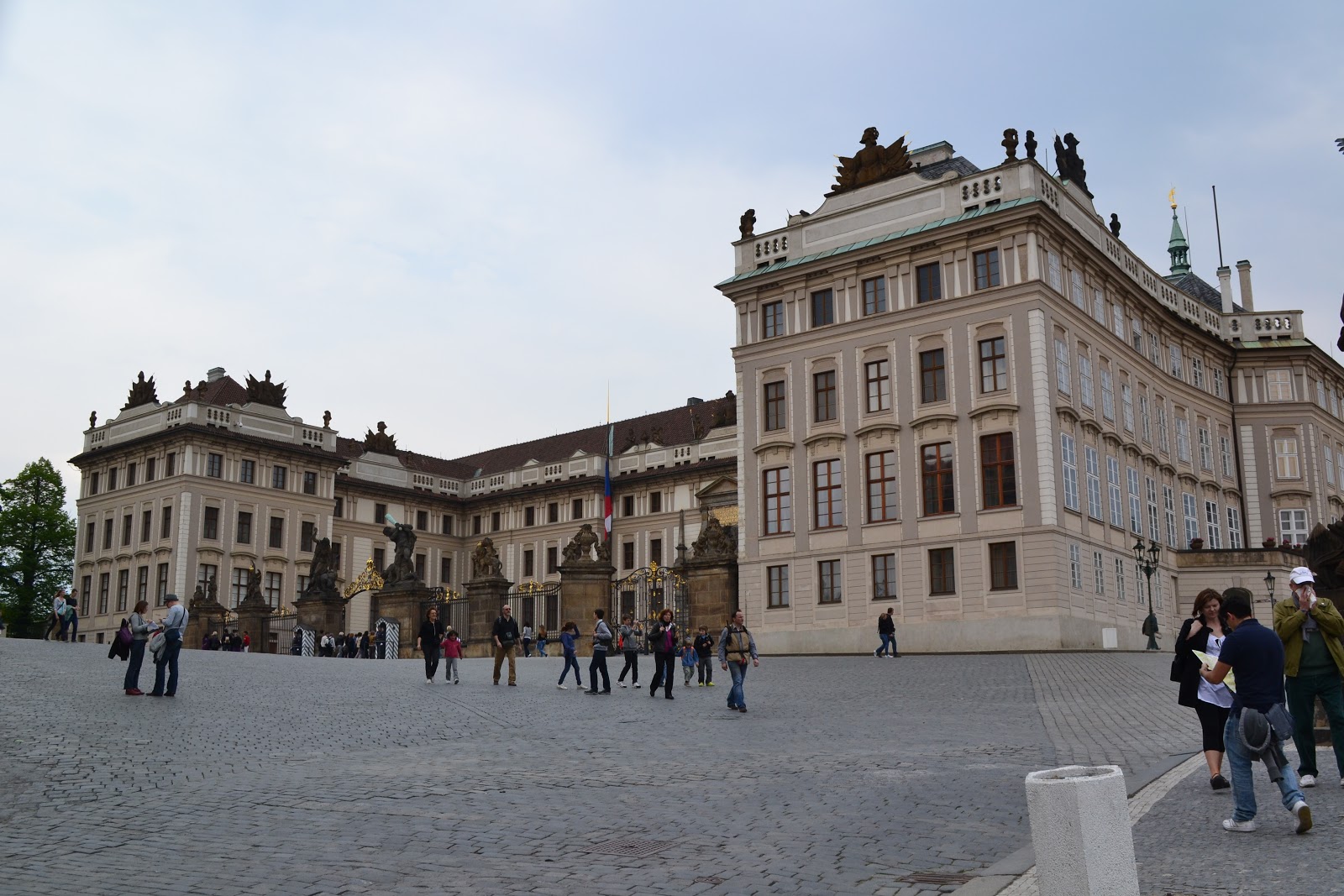
We then began the trek up the hill to castle. Somehow we found ourselves right on time for the changing of the guards. It was not as elaborate as others I have seen, but it is still interesting to see how different cultures go about similar activities. Now, this castle is not a castle in the British form of the word. It was more like a small community with a giant Cathedral in the middle. The castle is now mostly used as government buildings, but the Cathedral is still in use. Outside of its amazing stained glass windows, the Cathedral was ok, but then again, I have ones like the Sagrada Familia and St. Peter’s Basilica to compare it to. The best part of the castle was definitely it’s amazing view. You could, rather clearly, see most of the city, which was pretty cool. There also seemed to be an abundance of newlyweds taking pictures on the castle grounds.
As the sun began to set, we headed back towards town to grab some dinner. We went to a lovely restaurant in Old Town Square (surprise, surprise) where I tried some Czech wine, traditional Czech roast beef and potato dumplings, and a plum roll for dessert. There was a small concert going on in the square, so we sat outside so we could listen and enjoy the spectacular colors filling the sky as the sun was setting. That night we went on a pub crawl, where we went to four different bars and clubs. We met and hung out with kids our age from London, Berlin, Brazil, and Denmark, which was pretty cool.
The next morning we woke up, got some breakfast, and after working through some fun problems with my bank, we headed into town, first making yet another stop in Old Town Square. This time we hit up the shops to buy some souvenirs and gifts. We also got some cheap lunch. It was then off to see the John Lennon Wall. On the way there, we wondered through a park, which just made us all wish it was summer. We made it to the John Lennon Wall, which is a wall where anyone and everyone has the right to right, draw, paint, graffiti or hang whatever they want to express themselves. It was created after the Communist rule to help encourage people to say or show what they felt about certain things. I thought it was absolutely amazing. After taking way too many pictures of the different graffiti and artwork, we each signed our names and I wrote a quote from Ferris Bueller’s day off (yea, it was necessary). We topped it all off with a little Rockchalk KU!
We then made our way to the Fred and Ginger Dancing building, an unusual modern building in Prague. Due to limited time, we couldn’t spend too much time looking at it before we had to head back to the hostel to grab our stuff. We then sadly said goodbye to Santiago, who headed back to Leeds, and hopped on our bus to Berlin.
Obsessed with Prague’s Old Town Square,
Jessica
Jessica
Subscribe to:
Posts (Atom)